
Tuesday, 31 March 2015
Riker Lynch and Allison Holker “Salsa” Dancing With The Stars Season 20 Week 3 (VIDEO)

Monday, 30 March 2015
Former feds charged with stealing Silk Road bitcoin

Former DEA agent Carl Force, 46, of Baltimore, the task force agent charged with going undercover to communicate online with Silk Road operator Ross Ulbricht, known as Dread Pirate Roberts, allegedly used several online aliases to extort hundreds of thousands of dollars worth of bitcoin from Ulbricht, according to a criminal complaint unsealed Monday. Force is charged with money laundering, wire fraud, theft and conflict of interest.
Prosecutors also charged Shaun Bridges, 32, of Laurel, Md., a former special agent with the U.S. Secret Service, who allegedly accessed Silk Road accounts using password information from a Silk Road customer service representative arrested in a drug sting. Bridges, who joined the Secret Service in 2009, is charged with wire fraud and money laundering.
The FBI shut down Silk Road and arrested Ulbricht on Oct. 2, 2013. Silk Road, a dark Web black market that traded in illegal drugs, counterfeit IDs and computer hacking software, required its buyers and sellers to do business in bitcoin, an anonymous digital currency that is difficult to trace.
A federal jury in New York convicted Ulbricht last month on drug conspiracy charges. Ulbricht, who will be sentenced in May, was also the target of an investigation in Maryland. Force and Bridges worked on the Maryland investigation.
Prosecutors say Force, in addition to his official undercover identity as "Nob," created several unauthorized online aliases, so he could conduct complex bitcoin transactions to steal from the government and Ulbricht.
In one transaction, Force, using his second alias, allegedly demanded Ulbricht pay him $250,000 in bitcoin not to disclose information to the government. Posing as a woman named Carla under the alias "French Maid," Force allegedly offered to sell Ulbricht information about the government's investigation in exchange for $100,000 worth of bitcoin.
Ulbricht paid the money, and Force deposited it into a personal account, IRS Special Agent Tigran Gambaryan wrote in an affidavit. Force allegedly converted some bitcoin to dollars and wired the money to his personal overseas bank account in Panama, the affidavit said.
Force also worked for and invested $110,000 in the California-based digital currency exchange company CoinMKT while still working for the DEA. The company featured Force in its pitches to venture capital investors as CoinMKT's anti-money laundering and compliance officer.
E-mails between Force and CoinMKT's CEO indicated that Force planned to stay at the DEA until the bitcoin exchange "hits it 'big time.' "
"I have a lot of down time at DEA so I am confident that I can handle all that needs to be done regarding Legal and Compliance on a daily basis," Force wrote.
Prosecutors say Force used his position at the DEA to steal money from accounts at CoinMKT. In one instance, Force allegedly directed CoinMKT to freeze a customer account. He then seized 223 bitcoins worth about $297,000 and transferred them to his personal Bitstamp digital currency account. He then exchanged the bitcoins for dollars and put the money in his personal checking account, court papers say.
Force, who earned about $150,000 a year as a DEA agent, made $757,000 in deposits to his personal bank account from April 2013 to May 2014, court papers show. During that time, Force paid off his mortgage and a government thrift savings loan while investing in real estate and bitcoin businesses, court papers say.
Authorities arrested Force on Friday. Force, a 15-year veteran, resigned from the DEA in May. He is in jail and will appear in court Thursday for a detention hearing.
Bridges, the computer forensics expert on the Baltimore investigation, allegedly stole more than $800,000 worth of bitcoin that he controlled during the Silk Road investigation and placed it into an account with Mt. Gox, a digital currency exchange in Japan. Silk Road reported a massive bitcoin theft Jan. 25, 2013, the same day Bridges attended an interview with the Silk Road administrator caught in the sting.
Bridges allegedly wired the funds to a personal U.S. investment account through nine transfers from March 6, 2013, to May 7, 2013. The final transfer on May 7, 2013, came two days before he personally sought a $2.1 million seizure warrant for Mt. Gox's accounts, court papers say.
Bridges, who joined the Secret Service in 2009, resigned from the Secret Service on March 18. He surrendered to authorities Monday and was released under pretrial supervision.
Bridges intends to fight the charges, his attorney Steven H. Levin said. Bridges "had an unblemished career in law enforcement for several years. He maintains his innocence," Levin said.
Saturday, 28 March 2015
Iran nuke talks enter critical phase this weekend

The talks are reaching a climax as leaders from across the world, including Israel and the U.S. Congress, watch to see if a historic deal emerges to curb Iran's nuclear program in return for a lifting of U.S. and Western sanctions. Negotiators are trying to conclude a general agreement by a self-imposed March 31 deadline, with details to be filled in by June.
Israel and many in Congress have warned that the Obama administration may grant too many concessions to get a deal that would allow Iran to violate an agreement and develop nuclear weapons once the punitive sanctions that have crippled its economy are lifted.
Congressional leaders have threatened to vote on increased sanctions if they do not like the terms. Israel has threatened military action to prevent Iran from obtaining nuclear weapons that could threaten the entire region.

In a sign of congressional skepticism about an agreement, the Senate voted 100-0 Thursday for a non-binding resolution that calls for new sanctions against Iran if it is caught cheating on any deal that is
reached.
Iran has insisted that its nuclear program is peaceful and that its technological quest to produce energy and medical isotopes is a sovereign right. The oil-rich nation wants the sanctions lifted so it can rejoin the global financial system and sell oil on the open market again
The United States has not changed its bottom line regarding a deal, and it is still committed to making sure Iran would need at least a year to produce enough highly enriched nuclear material for a bomb if it broke the agreement, a senior administration official told USA TODAY. The official, who was not authorized to comment on the sensitive negotiations, asked not to be identified.
On Friday, Ali Akbar Salehi, head of the Atomic Energy Organization of Iran, told Mehr News that "a mutual understanding" covering much of the deal has been reached.
"A couple of technical issues are still remaining unresolved which we are working on," Salehi said. "There are difficult issues to be resolved."
Although the U.S. has taken the lead in the Iran talks, Britain, France, Germany, Russia and China also are participating.
In Washington, British Foreign Secretary Philip Hammond said the parties were "better than halfway" to a deal, according to the Associated Press.
French Foreign Minister Laurent Fabius told reporters in New York on Friday, "There has been some progress, but there are things which are not yet solved." Fabius arrived in Lausanne on Saturday. His British and Russian counterparts have said they will join the talks over the weekend as well.
Issues still to be resolved involve the number and types of centrifuges Iran can use to produce nuclear fuel, the ability of inspectors to gain access to all possible nuclear sites and Iran's willingness to discuss past efforts to produce nuclear weapons.
2 remain missing after deadly NYC blast

Using cranes, rakes, face masks and hard hats, officials scoured the area and dug through debris. No fatalities were reported, but police officials said two people who had been at a sushi restaurant in one of the buildings were missing. Mixed-use, commercial and residential buildings at 121, 123 and 119 Second Avenue were destroyed, and another adjoining building was badly damaged.
"We are still actively searching for two individuals," NYPD spokesman Sgt. Carlos Nieves said Saturday afternoon. "We have two canine, cadaver seeking dogs at the location assisting in the recovery efforts."
Meanwhile, four of the injured remained in critical condition Friday afternoon at local hospitals, 24 hours after a suspected gas explosion rocked the area and triggered a seven-alarm blaze that firefighters continued to mop up, New York City Mayor Bill de Blasio said during an afternoon City Hall news conference.

Authorities also were exploring whether a third person was unaccounted for, NYPD Chief of Detectives Robert Boyce said, according to the Associated Press.
With the fire still smoldering and the building debris dangerous, investigators have not yet been able to get into the basements of the devastated buildings, said de Blasio. However, he said preliminary investigation results showed "there may have been an inappropriate accessing" of the gas line that serves the building where the blast occurred.
"There's certainly a possibility of impropriety," added de Blasio, who also praised firefighters, police and other emergency responders, and said "our hearts go out to the families of all who are affected, and the people of the neighborhood."
The firefighting and cleanup work at the scene of the Second Avenue disaster scene near East 7th Street may continue for as long as a week, said city Fire Commissioner Daniel Nigro. Once the site is declared safe, firefighters will sift the debris searching for potential victims and clues to the disaster's cause, he said.
The City Hall news briefing presented a clearer but still incomplete overview of the explosion, ensuing inferno and chaos that forced scores of residents, workers and visitors to scramble from the buildings.
A Consolidated Edison crew was in the basement at 121 Second Ave. at about 2 p.m. Thursday to meet with contractors about pipes that had been installed in preparation for a planned upgrade of the building's gas service, a police official and utility executive said.
The utility crew told the contractors additional work was needed and left at approximately 2:45 p.m. without noticing any signs of a gas leak, officials said. Con Edison President Craig Ivey said the gas utility crew's findings meant gas was not yet flowing to the new pipes on Thursday.
The owner of the Sushi Park restaurant located on the building's first floor smelled gas at approximately 3 p.m., officials said. He notified the building owner, who in turn contacted one of the contractors, Boyce said. The city fire department received the first emergency 911 alert about the blast roughly 17 minutes later.
No one called 911 or Con Edison before the explosion, said de Blasio. He urged New Yorkers to contact the emergency hotline or the utility immediately if they smell gas. The mayor is also now accepting donations to help those affected by the building collapse.
One of the building contractors and a relative of the five-story structure's owner were among those injured in the explosion and fire, officials said. Police had not yet issued official missing persons reports on the two people who haven't been located, di Blasio's office said earlier on Friday.
Firefighters poured gallons of water Friday over the wreckage, a giant wave of crumbled brick, twisted metal and splintered wood.
Tyler Figueroa told the Associated Press Thursday night that his 23-year-old brother, Nicholas, disappeared after going on a date at the Sushi Park restaurant.
Figueroa said that the couple was paying for their meal when the explosion rocked the building and surrounding area. Nicholas Figueroa's date, who has been hospitalized with injuries, remembers only stumbling outside before losing consciousness, the brother told the Associated Press.
"I just pray my brother shows up," he said. "We just hope my brother comes back."
Contributing: Yamiche Alcindor and Ashley Day. Marisol Bello reported from McLean, Va.
Clinton wipes server after handing over e-mails
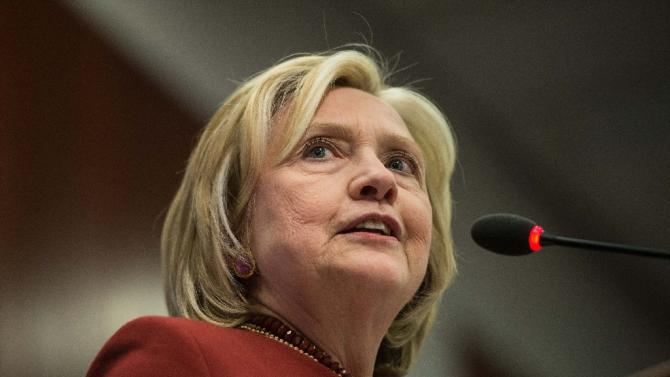
Former secretary of State Hillary Rodham Clinton decided to "wipe her server clean" and permanently delete all e-mails from the personal server, according to the head of a House committee investigating the terrorist attacks in Benghazi, Libya.
Rep. Trey Gowdy, R-S.C., said Clinton also has refused to turn over the server for an outside review as he and other Republicans have sought.
"Not only was the secretary the sole arbiter of what was a public record, she also summarily decided to delete all e-mails from her server ensuring no one could check behind her analysis in the public interest," Gowdy said in a statement issued Friday.
Clinton, who is likely to announce her candidacy for the Democratic presidential nomination soon, has faced intense scrutiny over her use of a private e-mail account, hdr22@clintonemail.com, and a personal server for official business during her time at the State Department.
Her lawyer David Kendall said there's nothing for the committee to see on the server from Clinton's time in office. Clinton had given the State Department all work-related e-mails covering her tenure at the department from Jan. 21, 2009, through Feb. 1, 2013, he said.
In a six-page letter released Friday, Kendall said it would serve no purpose for Clinton to relinquish her server because Clinton's IT advisers have confirmed "there are no hdr22@clinton.com e-mails from Secretary Clinton's tenure as Secretary of State on the server for any review, even if such review were appropriate or legally authorized."
After Clinton's team determined which e-mails were to be turned over to the State Department last year, Clinton choose to delete her personal e-mails and asked her aides to change the settings on the account to retain e-mails for only 60 days, Kendall said. The account was no longer in active use at that point, he said.
Clinton has called on the State Department to release the more than 30,000 work-related e-mails her lawyers handed over to the agency on Dec. 5, 2014. It's up to the department to review them for sensitive information and decide what to share with the public.
Gowdy seems prepared to take further action, saying he would work with the GOP leadership in the House on "next steps." Earlier this month, House Speaker John Boehner, R-Ohio, demanded Clinton turn over her server to an independent arbiter but stopped short of saying the House would seek a subpoena for the server.
Gowdy said Clinton would have to answer questions from lawmakers — something her aides say she is prepared to do.
Clinton is "ready and willing to come and appear herself for a hearing open to the American public," her spokesman Nick Merrill said in a statement.
He added that Clinton's representatives have been in touch with Gowdy's committee and the State Department to make it clear Clinton would like the State Department to publicly release her work-related e-mails "as soon as possible."
Co-pilot 'obsessed' with Alps; flew crash area as a boy
Andreas Lubitz, the co-pilot who authorities say flew a Germanwings plane with 150 people aboard into the French Alps, was "obsessed" and "passionate" about the mountainous region and had flown it several times as a child, French and German media report.
Lubitz and his family, along with other members of a gliding club in his hometown of Montabaur, Germany, would take trips with other members to a club in the town of Sisteron, France, about 30 miles from where the Airbus A320 went down Tuesday,

The area, with its numerous peaks and valleys and stunning panoramas, is popular with glider pilots. In the final moments of the Germanwings flight, Lubitz overflew the major turning points for gliders flying from one peak to another, according to local glider pilots, the Associated Press reported.
French investigators said the plane, with Lubitz at the controls and the locked-out pilot trying desperately to break through the cockpit door, flew for about 10 minutes after leaving its 38,000-feet cruising altitude, finally descending into the side of the mountains.
 Francis Kefer, a member of the local French gliding club, told France's i-Tele television that the Lubitz family and other members of the Montabaur club came to the region regularly between 1996 and 2003.
Dieter Wagner, a member of the Montabaur club, said he recalls that Lubitz had participated in one of the gliding courses in the Alpine region with Wagner's niece, who was a good friend, Le Parisien reported.
"He was passionate about the Alps and even obsessed," Wagner said. "I'm sure he knew the crash area because he had flown it in a glider."
Ernst Müller, 70, and another member of the German club, said he is "certain that Andreas has participated in at least one or two internships with us in Sisteron," Le Parisien reported. Officials at the club would not comment Saturday, the AP reports.
Lubitz and his family, along with other members of a gliding club in his hometown of Montabaur, Germany, would take trips with other members to a club in the town of Sisteron, France, about 30 miles from where the Airbus A320 went down Tuesday,
The area, with its numerous peaks and valleys and stunning panoramas, is popular with glider pilots. In the final moments of the Germanwings flight, Lubitz overflew the major turning points for gliders flying from one peak to another, according to local glider pilots, the Associated Press reported.
French investigators said the plane, with Lubitz at the controls and the locked-out pilot trying desperately to break through the cockpit door, flew for about 10 minutes after leaving its 38,000-feet cruising altitude, finally descending into the side of the mountains.
Dieter Wagner, a member of the Montabaur club, said he recalls that Lubitz had participated in one of the gliding courses in the Alpine region with Wagner's niece, who was a good friend, Le Parisien reported.
"He was passionate about the Alps and even obsessed," Wagner said. "I'm sure he knew the crash area because he had flown it in a glider."
Ernst Müller, 70, and another member of the German club, said he is "certain that Andreas has participated in at least one or two internships with us in Sisteron," Le Parisien reported. Officials at the club would not comment Saturday, the AP reports.
Friday, 27 March 2015
Test Drive: 2016 Mazda6 is sexy outside, classy inside
Despite its much-improved appeal, which generated much-improved sales, Mazda6 remains an afterthought among midsize sedans, outsold nearly eight-to-one by the Honda Accord, which seems most like the Mazda, and almost three-to-one by the oft-overlooked Subaru Legacy.
The freshened 2016 version now is upon us, and the model's sales jumped 28% in February, the month it went on sale.
Mazda wisely left the 2016's outsides almost untouched — modified grille area and that's it — while attending to the interior with richer materials, nicer dashboard and instruments.
Subscribe to:
Posts (Atom)